

Table Of Contents
Sourcing non-RO household water filters often becomes a race on price or stage counts, leaving distributors exposed to housing leaks, unsupported filtration claims and expensive service calls. If the delivered system does not match local installation and treatment requirements, an attractive unit price can become a costly product launch. The solution is an engineering-first approach to component evaluation and procurement.
To select a commercially workable non-RO filter range, evaluate four connected criteria: the specific contaminant-reduction claims covered by the product's certification[1], the integrity of the supplied housing and seals, finished-cartridge performance, and the local cost of delivering the replacement service.
For distributors serving Southeast Asia and the Middle East, putting together a robust product lineup requires analyzing how a factory quotation translates into field performance. The following five buying decisions connect technical specifications to installation, customer expectations and the replacement business.
How do you match a non-RO system to the actual water problem?
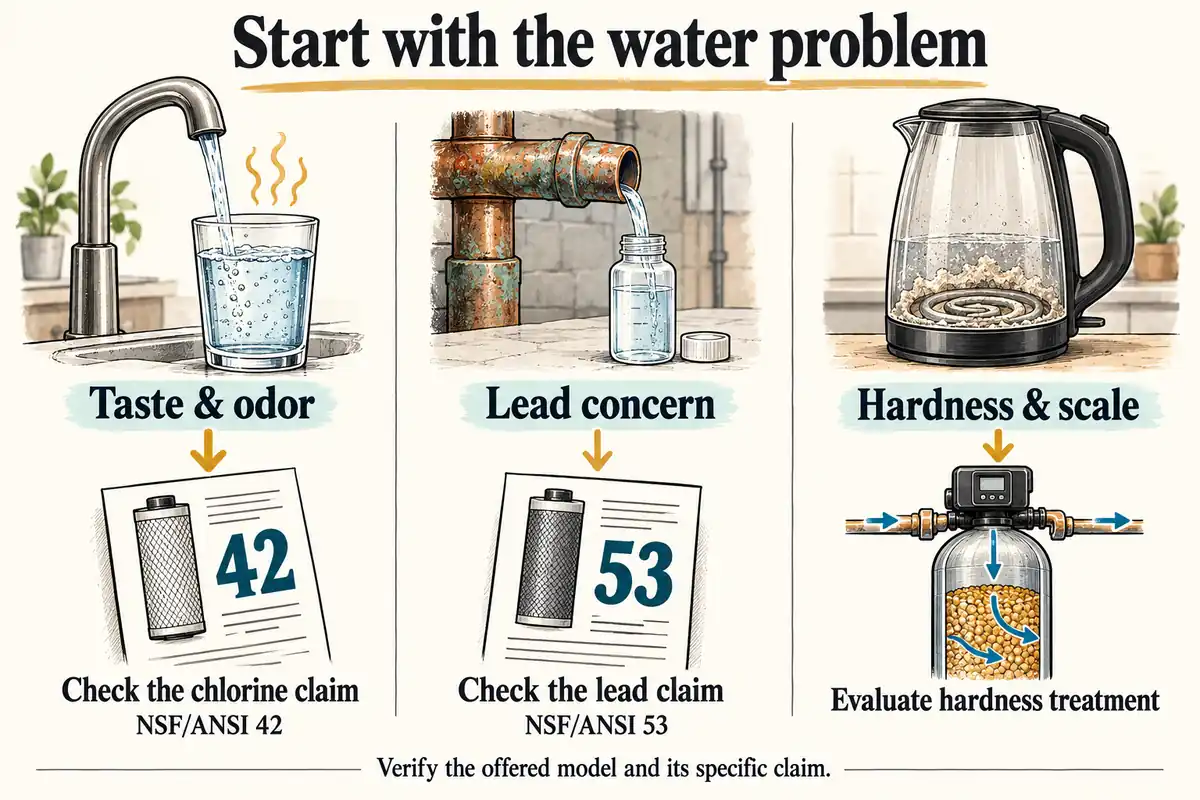
Treating all non-RO filtration needs with a single generic cartridge setup is a recipe for customer dissatisfaction. A product selected for chlorine-related taste is not automatically the right product for a specified lead or microbial treatment task. Start with the outcome the customer needs, then evaluate the offered system for that job.
Segment the range by treatment task: NSF/ANSI 42 addresses aesthetic claims such as chlorine, taste and odor; NSF/ANSI 53 addresses specified health-related contaminant reductions[1]. Match the product's actual claim to the concern instead of treating a certification number as a fixed media recipe.
Decoding the 0.01-Micron Barrier
In my years of auditing manufacturing partners, I have often seen suppliers use "ultrafiltration" as a generic marketing term. The EPA describes ultrafiltration particle separation down to approximately 0.01 micrometers, while distinguishing microporous filtration from dissolved-solids removal[2]. This is a technology-scale reference, not a blanket performance guarantee for every household UF cartridge on the market.
As a distributor, evaluate the finished cartridge and its intended assembly, not only the membrane's advertised pore size. The integrity of the complete membrane unit is a separate performance question[3]. Include how the cartridge seats, how the flow path is separated, and how the relevant claim was demonstrated in the sample review.
Aesthetic vs. Health Claims
The most common mistake I see in B2B procurement is assuming "non-RO" is synonymous with "incapable of reducing lead." The CDC identifies carbon-based home filters that can reduce lead[4]; the deciding factor is the specific product and its verified reduction claim.
When you evaluate a factory's documentation, keep these two standards distinct:
- NSF/ANSI 42: Addresses aesthetic claims such as chlorine, taste, and odor reduction.
- NSF/ANSI 53: Addresses specified health-related contaminant reductions, such as lead, VOCs, and MTBE.
An NSF/ANSI 42 claim does not establish a lead-reduction claim. Where lead is a defined concern, compare products certified for that reduction and inspect the identity and scope of the offered model. Evaluate the proposed treatment mechanism on its merits rather than prescribing one media combination for every supply.
Regional Segmentation Strategies
Do not treat your target markets as uniform territories. An apartment supplied by treated municipal water and a home using a private well may present different sourcing tasks, even within the same market. Use the available water analysis, storage arrangement and intended installation to make the distinction.
| Defined Water Issue | Configuration to Evaluate | Buying Decision |
|---|---|---|
| Sediment loading and a separately identified microbial concern | A serviceable sediment stage and a treatment barrier validated for the specified target | Compare maintenance access, operating evidence and the finished system's claim; do not let a pore-size label answer every question. |
| Chlorine-related taste or odor | A carbon configuration evaluated for that duty | Compare capacity at the intended flow and inlet conditions; add other treatment only for an established requirement. |
| Hardness and scale | A dedicated hardness-treatment route, with any additional filtration chosen for its own task | Establish the hardness objective and maintenance requirements before comparing general filter prices. |
Why is filter housing and seal design a critical warranty safeguard?
Focusing exclusively on filtration media while ignoring the mechanical housing leaves an important purchasing risk unresolved. A cracked housing or leaking joint can turn a filter sale into a repair visit and a property-damage claim. Give the complete supplied assembly its own place in the acceptance decision.
Evaluate housing and seal integrity alongside filtration performance. Compare the rated operating conditions, the tested configuration and the cartridge-change procedure. A strong housing specification does not establish the suitability of every fitting or seal supplied with it.
Understanding Pressure Limitations
When I review housing specifications, I always look for structural benchmarks rather than generic material listings. For example, Pentair's Traditional Standard housing sheet specifies a maximum pressure of 125 psi (8.6 bar) and identifies selected models' NSF/ANSI 42 certification as covering material and structural integrity[5].
This is a critical distinction: the cited certification concerns the identified housing and its stated scope. It is not evidence that an empty housing removes contaminants, and it is not a rating for a different assembly. Keep a normal operating limit separate from the loading applied during a particular pressure test.
The Geometry of a Reliable Seal
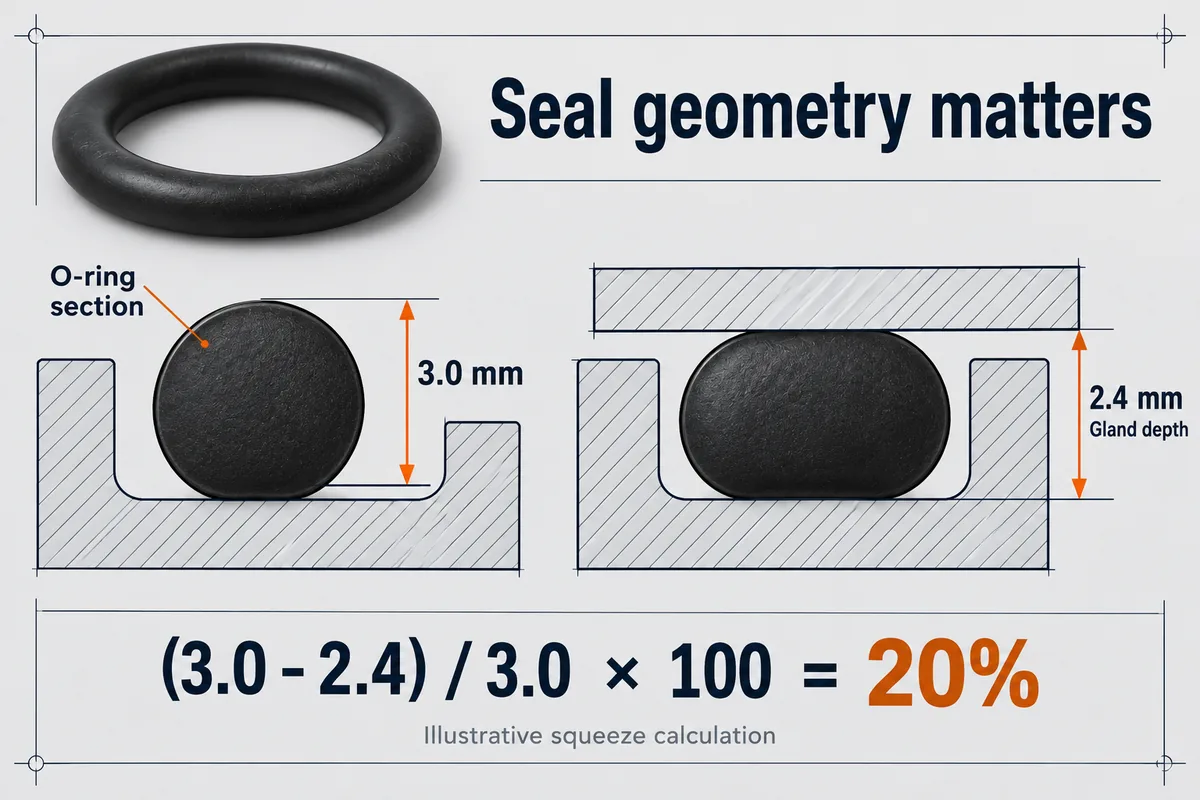
Do not let suppliers oversimplify the discussion to "single versus double O-rings." Review the seal and its groove together. Parker's guidance identifies squeeze, gland fill, clearance, tolerances and surface finish as design considerations[6]:
- Squeeze: The physical compression of the O-ring.
- Gland Fill: The percentage of the groove volume occupied by the O-ring.
- Clearance & Tolerances: The gap between the mating plastic parts.
We can illustrate the concept of squeeze using a basic calculation:
Squeeze (%) = [(O-ring cross-section − gland depth) / O-ring cross-section] × 100
If a system uses a hypothetical 3.0 mm cross-section O-ring in a 2.4 mm deep gland, the calculation yields:
[(3.0 mm − 2.4 mm) / 3.0 mm] × 100 = 20% squeeze
This 20% value illustrates seal geometry, not a universal design prescription. Both insufficient and excessive compression deserve review against the actual seal arrangement, material and tolerances. Include opening, inspection and correct reassembly in the sample's cartridge-change evaluation.
Procurement Safeguards
When finalizing a purchase order, I recommend freezing the evaluated component identities. Record the approved housing and head materials, seal compound, fittings and cartridge interface. Agree on how substitutions will be reviewed before shipment, so a change is visible rather than arriving under the same product label. Select materials for the intended conditions; a polymer or elastomer name alone is not a quality grade.
Does carbon iodine number predict cartridge service life?
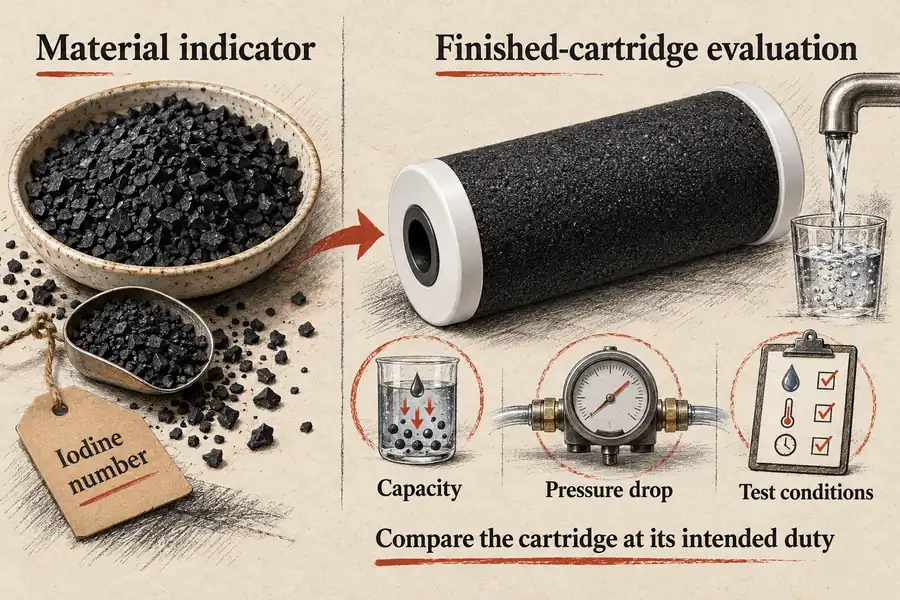
A high iodine number can make a carbon quotation look persuasive, but it describes a different buying question from the performance of the finished cartridge. If the comparison stops at the raw material, purchasing may miss a difference that matters at the customer's draw rate.
No, iodine number alone cannot predict cartridge service life. ASTM D4607 describes it as a relative indicator of carbon porosity and limits extrapolation to adsorption of other substances[7]. Compare the complete cartridge at its intended duty before paying for a headline material advantage.
ASTM D4607 and Microporosity
To understand carbon quality, keep the measurement tied to its method. ASTM D4607 expresses iodine number as the milligrams of iodine adsorbed per gram of carbon under the stated test conditions. It can inform the material comparison; it does not directly measure every contaminant-reduction claim or the service life of a finished block.
A comparison such as 1100 mg/g versus 900 mg/g therefore needs context. Across different materials and processing routes, it is not a direct count of useful pores or a proportional increase in cartridge capacity. Put the material declaration beside the finished-product result instead of converting the difference into a replacement promise.
The Dynamics of Carbon Block Extrusion
For an extruded block design, examine how the approved formulation and processing route relate to the sample and the finished-cartridge results. I have seen carbon blocks made with high iodine-value raw materials perform worse than low iodine-value blocks simply because the extrusion process overheated and glazed the outer surface of the block. The buying lesson is to evaluate the finished element rather than assume that a raw-material specification settles the comparison.
- Identify raw carbon and material indicators
- Identify the approved block formulation and process
- Compare at stated flow and inlet conditions
- Evaluate capacity, pressure drop and service requirements
Comparing Cartridge Specifications
When you evaluate carbon cartridge offers, compare the actual flow, inlet challenge concentration, stated reduction endpoint and rated capacity together. Resolve different test conditions before treating two capacity figures as comparable. Keep pressure drop and the replacement instructions alongside those figures.
Contact time belongs in that comparison, but wall thickness alone does not establish cartridge life. For a granular carbon bed, empty-bed contact time relates bed volume to volumetric flow[8]. That relationship explains why contact conditions matter; it does not transfer a treatment-plant operating time to a household carbon block. Pay for a finished-cartridge result that meets the intended duty.
How should distributors compare UF membrane area and flux?
Advertised membrane area is useful only when it is connected to the output required from the assembled cartridge. Start with the target flow and the installation's available conditions, then examine whether the offered module can deliver that combination.
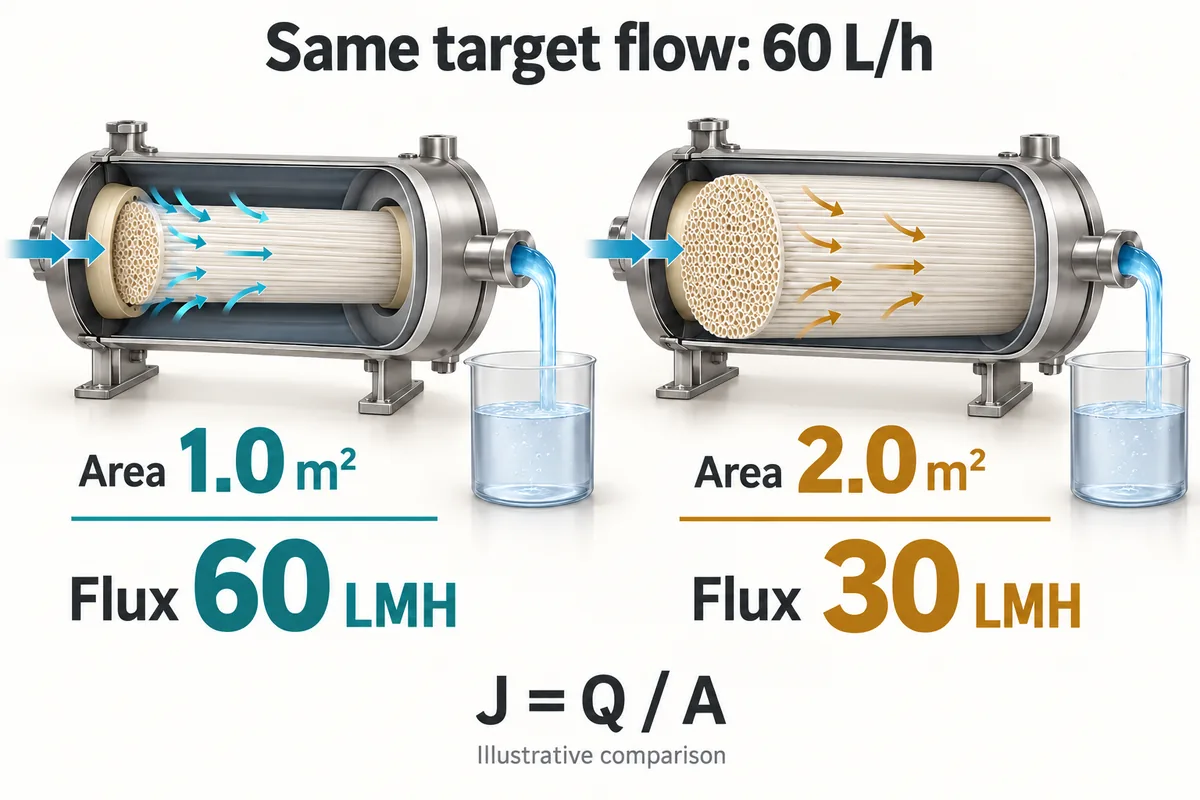
Compare membrane area and target filtrate flow through J = Q / A. More active area lowers the required flux at the same output. The purchase decision still depends on finished-module flow, operating conditions, integrity and maintenance—not on area alone.
Understanding Flux Dynamics
In ultrafiltration engineering, we rely on a fundamental relationship:
J = Q / A
Where:
- J = membrane flux, in L/(m²·h), often written as LMH
- Q = filtrate flow, in L/h
- A = active membrane area, in m²
Let us look at an illustrative comparison of two cartridge designs delivering a target household flow rate of 60 L/h:
- Option A — 1.0 m² active area: 60 L/h ÷ 1.0 m² = 60 L/(m²·h)
- Option B — 2.0 m² active area: 60 L/h ÷ 2.0 m² = 30 L/(m²·h)
Option B requires half the average flux for the same target output. That is the conclusion the arithmetic supports. How the cartridges compare in sustained operation depends on their actual membrane properties, pressure, inlet water, temperature and maintenance; the area calculation does not quantify a lifetime advantage.
Why More Area Isn't a Cure-All
The EPA's membrane guidance defines flux as filtrate flow per unit of membrane area[3] and treats integrity as a separate question. Twice the advertised area does not establish twice the useful life.
Review how the assembled module distributes flow and how the claimed active area is used. A bundle-area figure is not a substitute for a relevant finished-module comparison. Ask for the arrangement and operating evidence rather than assuming that a crowded bundle must behave in one particular way.
When reviewing a supplier's UF cartridge:
- Establish how the offered module's active area is defined.
- Review the flow path, cartridge seating and integrity evidence.
- Compare finished-module flow at the stated inlet pressure, temperature and water conditions.
Do not blindly apply municipal water plant operating limits to a residential cartridge, but use the math to push back on unrealistic factory claims.
How does the replacement channel change the buying decision?
Designing a replacement program around the shortest change interval to force repeat sales often alienates customers and drives up logistics costs. If your service network spends more on truck rolls than the margin on the cartridge, your business model fails.
Compare the cost of delivering each supported replacement schedule through the actual channel. Fewer service visits can reduce customer or service-program spending, while distributor margin also depends on purchase prices, selling prices, logistics, inventory and support. Calculate those separately instead of treating cartridge frequency as profit.
Replacement Unit Economics Analyzed
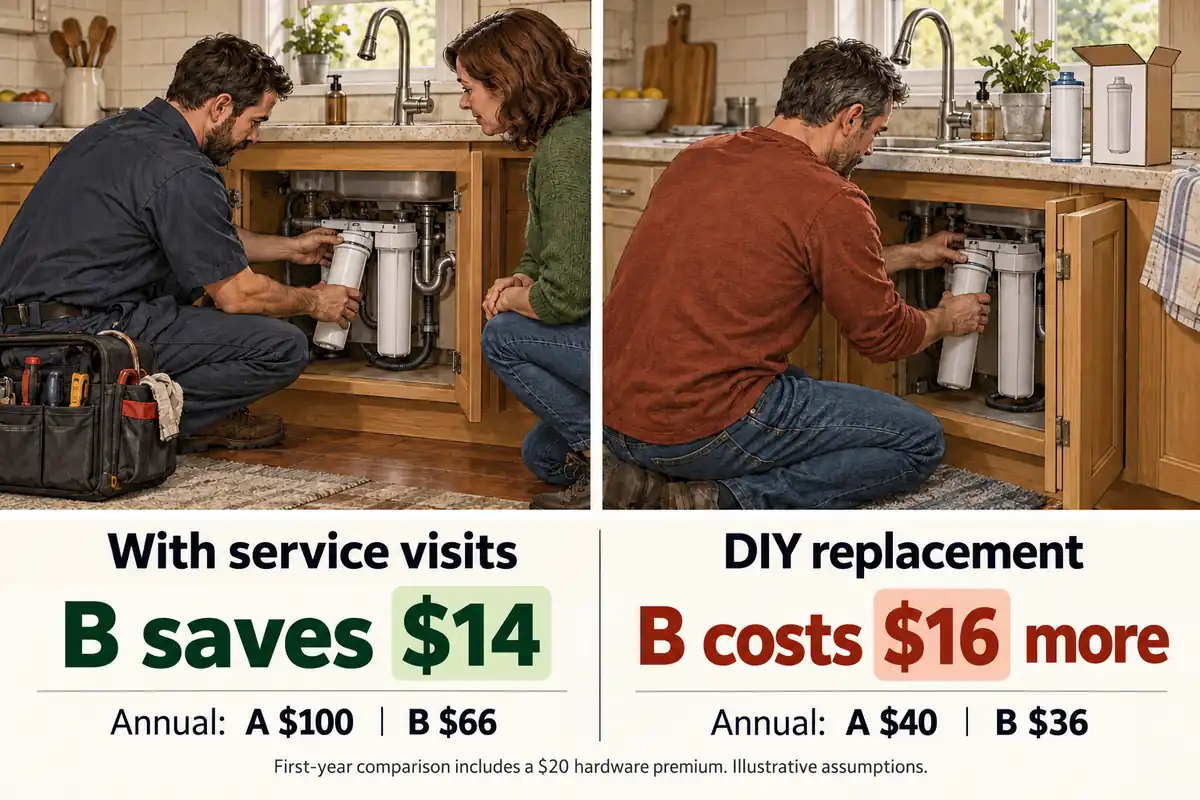
Let us analyze how a distributor's service channel changes the buying decision. We will use a hypothetical, explicitly illustrative one-year comparison. In this scenario, we assume both Option A and Option B achieve the exact same treatment standard, but use different cartridge designs.
| Replacement Cost Assumption | Option A | Option B |
|---|---|---|
| Replacement events per year | 4 | 2 |
| Cartridge cost per event | $10 | $18 |
| Delivery & service per event | $15 | $15 |
| Annual replacement/service cost | $100 | $66 |
In this serviced-network model, Option B's cartridge has a higher assumed purchase price, but annual replacement spending is $34 lower. With an assumed $20 initial hardware premium, the customer's first-year total is still $14 lower. These are worked assumptions, not quotations, verified lifespans or evidence that one system is higher quality. They show how service delivery can reverse a comparison based on cartridge price alone.
Direct-to-Consumer / DIY Replacement Channel
Now, let us remove the $15 professional service charge to simulate a direct-to-consumer retail model where the customer changes the cartridge themselves:
- Option A annual cartridge cost: 4 × $10 = $40
- Option B annual cartridge cost: 2 × $18 = $36
With the service fee removed, the annual difference shrinks to $4. A $20 initial hardware premium now makes Option B's first-year total $16 higher under the same simplified assumptions. The hardware and cartridge comparison has not changed; the service channel has changed the result.
Channel Strategy and Housing Interfaces
I advise B2B importers to align their cartridge interface with their service model:
- Proprietary quick-change interfaces: Evaluate the benefit to the intended user and service network alongside replacement availability, revision control and supplier continuity. A specific connection can organize the installed base, but it does not by itself guarantee margin or eliminate alternative replacements.
- Standard-format housings and cartridges: These may suit channels that prioritize local replenishment and a broader replacement choice. Verify actual dimensions, sealing and performance; a "10-inch" or double-open-end label is not proof that every proposed cartridge is interchangeable.
Frequently Asked Questions
Can non-RO household filters reduce TDS?
Ordinary sediment filters and UF are not a broad dissolved-salt reduction route. Carbon may target particular dissolved contaminants without making a standard carbon/UF unit a desalination system. If bulk TDS reduction is required, evaluate a dedicated route such as RO or appropriate demineralization. Keep hardness treatment distinct: ion-exchange softening replaces hardness ions, while RO is a different treatment process[1]. The label "non-RO" alone does not specify every technology in a system.
How do I verify a Chinese manufacturer's housing burst pressure rating?
Request the report for the offered configuration, not just a pressure number in a brochure. It should identify the housing and head, relevant seals and fittings, test method and edition, applied loading, temperature, duration or cycle count, and result. Confirm which cyclic and hydrostatic requirements apply to that device class. Keep normal working pressure separate from proof or burst testing, and resolve any difference between the tested components and the proposed shipment. Pentair's published 125 psi example is an operating specification for the identified housings, not a universal burst threshold.
Is coconut shell carbon always superior to coal-based carbon in household filters?
No. Compare the evaluated carbon grade and the finished cartridge for the target contaminant and duty. ASTM notes that the relationship between iodine number and surface area cannot be generalized across carbons and varies with raw material, processing and pore distribution[7]. A precursor label is therefore a starting point for the material description, not a complete ranking of household filtration performance. Give greater weight to relevant finished-product evidence than to a universal coconut-versus-coal claim.
What is the ideal replacement interval for non-RO sediment and carbon cartridges?
Use the specific product's rated capacity and replacement instructions, together with the intended water and use conditions. CDC advises changing filters according to the manufacturer's recommendations[4]. Keep time-based maintenance, treatment capacity and changes in operating performance visible in the service plan; do not choose a single month count merely to make replenishment revenue predictable.
Conclusion
Sourcing non-RO household water filters calls for connecting treatment claims, the supplied assembly and the replacement business. A useful technical review makes the tradeoffs visible before the order: what the configuration must do, which components were evaluated, and how the channel will maintain and replenish it. To discuss a sourcing requirement with MuphoenixEco, share your available water information, installation needs and local replacement model. That gives the conversation a practical basis for comparing options.
References
- [1]
- [2]
- [3]
- [4]
- [5]
- [6]
- [7]
- [8]

Environmental technology and smart eco-appliance solutions.
Share your application, water conditions, and product requirements with our team.

